Juliana
Author • JUL 12, 2026
When I arrived in Nunavut, I was immediately impressed by the number of talented artists and crafters in my community.
I got curious and went online to learn more about Inuit art and crafting. What I found was a set of reasons that perfectly explained why I have encountered so much talent here.
Nunavut has one of the highest numbers of artists in Canada
The data speaks for itself. When I read the numbers, they perfectly matched what I was seeing around me.
Research by Hill Strategies, using Statistics Canada census data, found that artists make up about 1.17 per cent of the labor force in Nunavut.
This is one of the highest rates in the country. It puts a territory of roughly 40,000 people on par with provinces that have millions of residents.
The number goes even higher when you look at single communities. In Kinngait, also known as Cape Dorset, artists make up an astounding 22.7 per cent of the labour force.
That is roughly one working artist in every four or five people, making it the most artistic community in Canada.
Furthermore, a study done for the Government of Nunavut found that more than 6,000 people in the territory make arts and crafts to some degree.
Some sell their work, while others create pieces for family, for gifts, or simply for themselves.
Why are there so many artists and crafters in Nunavut?
To understand why there is so much creativity here, you have to look at how history, land, and community come together.
Making things in the Arctic did not begin as a pastime; it began as survival. If you needed boots, coats for forty-below temperatures, tools, or sleds, someone had to make them by hand. These skills were taught early and taken seriously because they were essential for living on the land.
That knowledge did not disappear when the way of life drastically changed for Inuit decades ago. Instead, it stayed in people’s hands, was passed down through families, and naturally evolved into a vibrant art form.
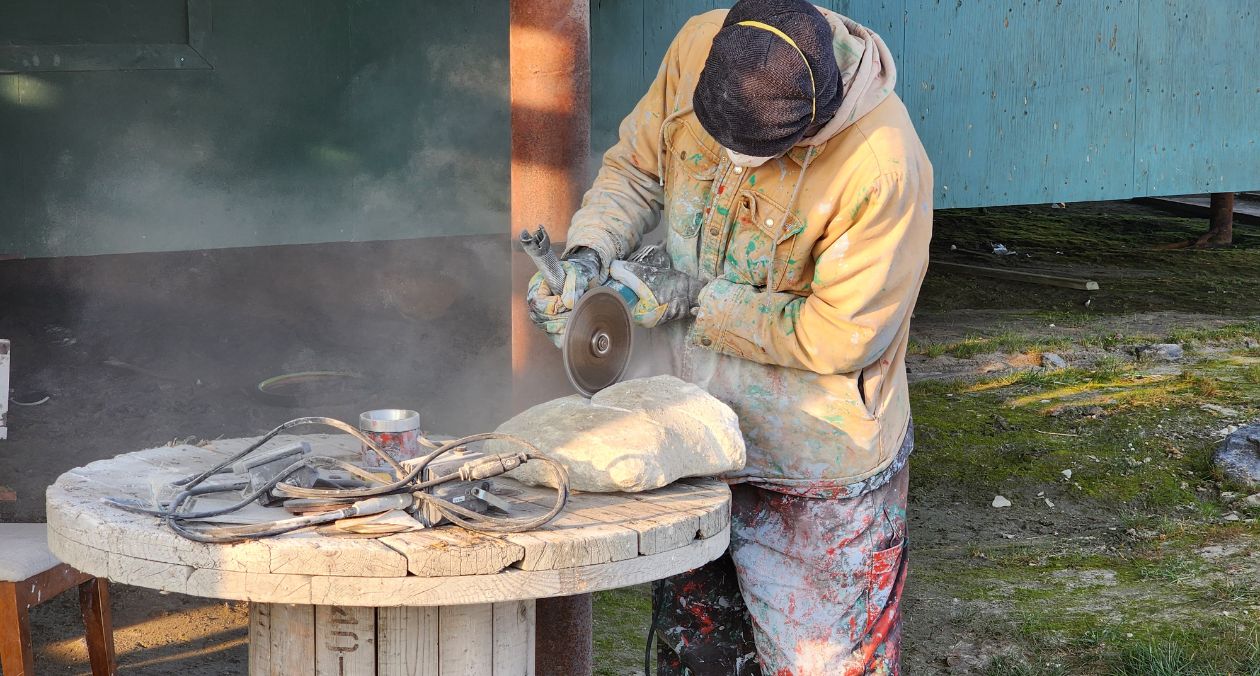
My neighbour, Goula Paneak, is a perfect example of this transformation. He learned his craft through family knowledge, but he started carving at a young age driven by an entrepreneurial spirit. Today, he is a prominent local carving artist here in my community, Clyde River. When I watch him work, I am looking at generations of acquired skill passed directly to the youth
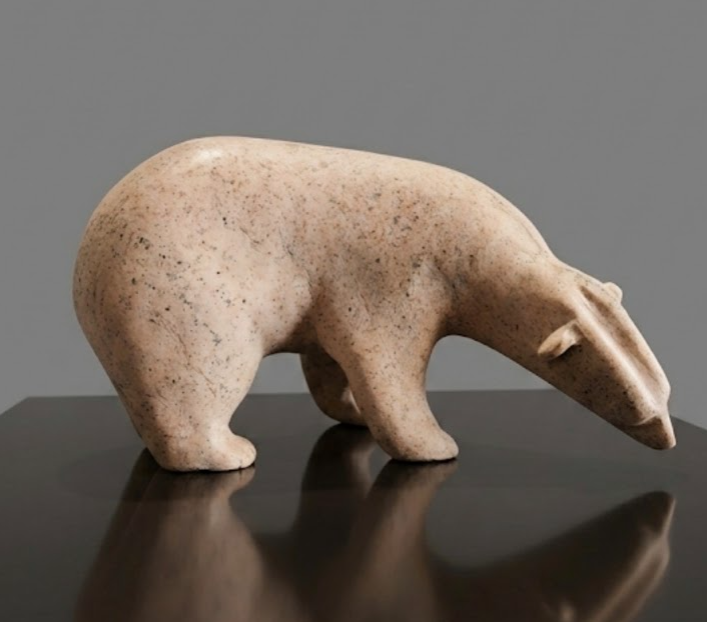
Polar Bear, by Goula Paneak.
Beyond tradition, this work also provides essential, independent income across the territory.
The handmade items crafted here carry a level of quality and ancestral history that is highly sought after across Canada and around the world. The Government of Nunavut estimates that the territory’s creative economy is worth around 37 million dollars annually, allowing makers to support their families on their own terms.
At the same time, the land itself provides endless materials, from soapstone and serpentine to caribou antler, bone, and sealskin. Working with these materials is a powerful way to stay connected to culture, support mental well-being, and pass stories and traditions down to the youth.
Yet, challenges remain.
Research shows that Nunavut artists have the lowest median income of artists anywhere in Canada, sitting around 10,700 dollars a year. Because of our remote geography, reaching southern markets where artists can sell their work for what it is truly worth remains a hurdle.
How to responsibly acquire Inuit art and handcrafted items
If reading this makes you want to support northern creators, I am glad. But please ensure you are buying responsibly.
Purchase directly from the maker whenever you can. Community Facebook groups, local Co-ops, and northern arts centers are great places to start.
A handmade parka, carving, or pair of mitts is never anonymous. Ask for the artist’s or seamstress’s name and remember it. Someone poured their time and knowledge into that piece, and they deserve to be recognized.
Do not try to negotiate the price down. Remember the median income of northern creators and pay what the item is worth.
Finally, take the time to learn about what you are acquiring. Find out where it came from, what materials were used, and the story or technique behind it.
Whether it is a stone sculpture or a handcrafted parka, the physical item is beautiful, but the cultural story behind it is the true treasure you are bringing home.
Inuit Arts and Crafts: Inside Canada’s Most Artistic Territory
The Questions You Never Thought to Ask About Water and Sewage in Nunavut